

Material Deep Dive A close examination of a single material—its histories, geologies, technologies, failures, contradictions, and future potentials.

Skylar Perez explores how color appears in soil, how those colors are classified in soil science, and how different approaches to color classification reflect different values about art, design, material, and place.
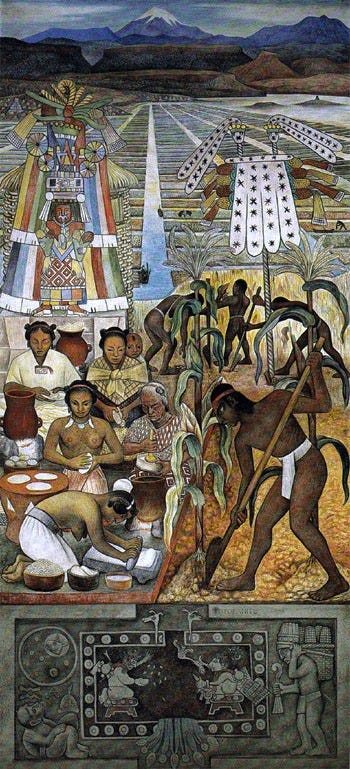
Soil is often introduced as the backdrop of human setting—a neutral ground beneath architecture, agriculture, and art. But soil is not neutral. It is one of the most chromatically expressive materials on Earth, carrying within its hues a record of geological formation, biological activity, chemical exchange, and human activity. To encounter soil closely is to encounter color not as surface but as process.
Across landscapes, soil expresses itself in deep reds, muted yellows, ashen grays, blues tinged with logged water, and blacks dense with organic life. Rather than aesthetic happenstance, these colors act as signals. They tell of oxygen and iron, of saturation and drought, of decomposition and genealogic geology. Soil color is the visible trace of invisible human and nonhuman labor, a slow choreography between rock, water, air, microbes, plants, and time.
In this sense, the soil behaves like a fantastically ever-changing microcosm. It is alive without being animated, expressive without intention, and composed without design. Its colors are not applied pigments. They emerge from conditions endured and processes sustained over long durations.
Why Soil Is the Color It Is
The chromatic logic of soil begins underground through pedogenesis, which is the gradual formation of soil from parent material under the influence of climate, organisms, topography, and time. As rock weathers, minerals are released and reorganized, interacting with water, oxygen, organic matter, and living organisms. Color emerges as one of the most immediate expressions of these interactions.
Iron plays a central role. In well-drained environments, iron oxidizes in the presence of oxygen, producing reds and yellows that stain the soil much like rust stains steel. In wetter or poorly drained conditions, where oxygen is limited, iron is reduced rather than oxidized, resulting in grays, greens, and bluish hues. Organic matter darkens soil as plant residues decompose and carbon accumulates near the surface, supporting dense microbial communities. Calcium carbonate and soluble salts lighten soils, producing pale whites and chalky tones common in arid and semi-arid regions.
These chromatic variations can be seen most clearly across soil strata and sections—the vertical layers that develop as soils form. A darkened surface horizon rich in organic matter gives way to underlying mineral layers shaped by leaching, accumulation, and chemical alteration. Reds and browns intensify where iron oxides collect in stable subsoils, while pale or mottled layers reveal fluctuating water tables and seasonal saturation. Soil color becomes a vertical archive, recording the movement of water, minerals, and energy through the ground.
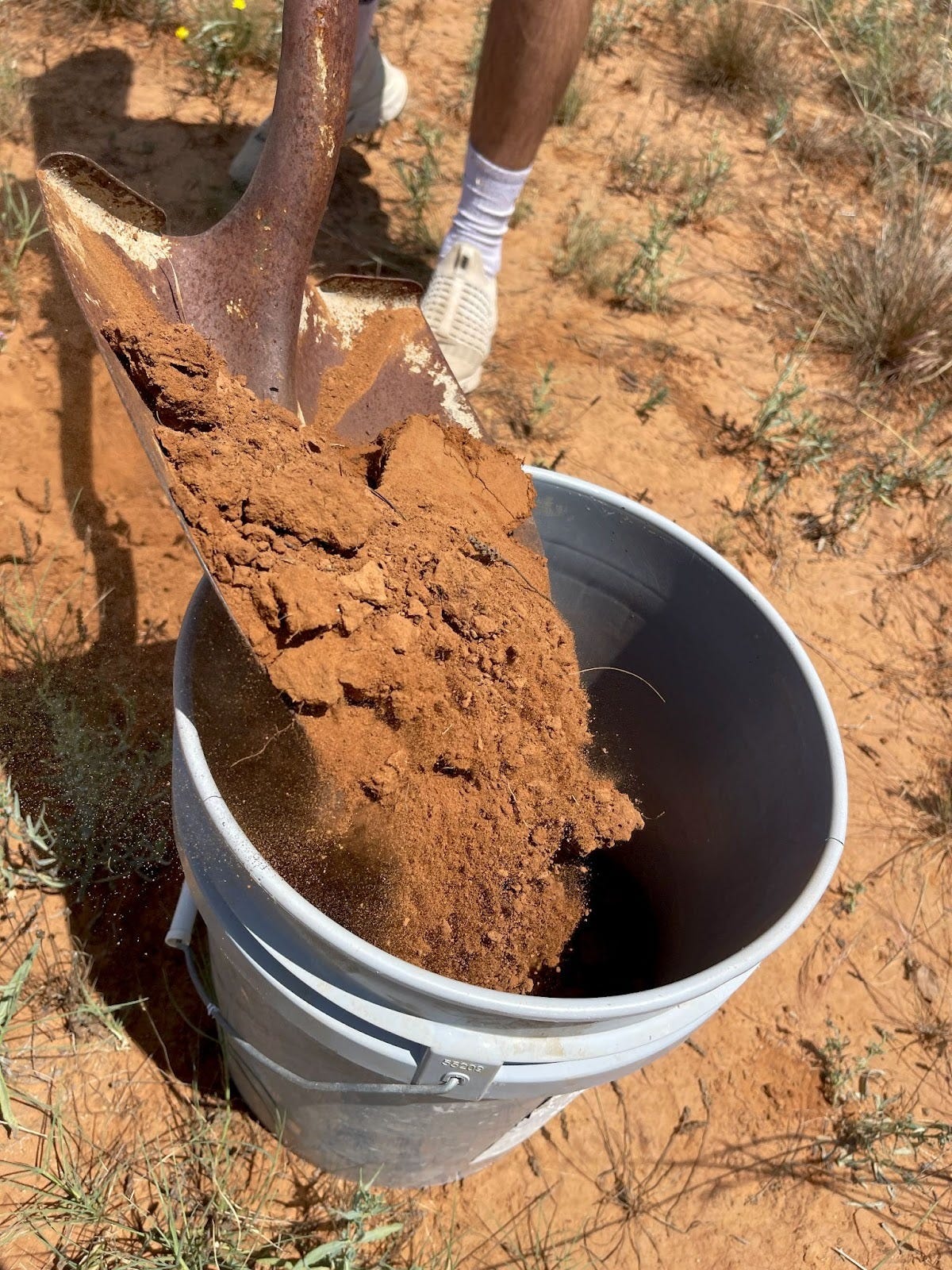
Color in soil is therefore relational. It depends on moisture, temperature, parent material, vegetation, and disturbance. It shifts across depth and time, recording cycles of wet and dry, growth and decay, stability and disruption. Soil color is not fixed. It is contingent, always responding to its environment.
To see soil color is to read a story of place.
Color, Classification, and Soil Taxonomy
In soil science, color is not solely descriptive. It is diagnostic. Alongside texture and structure, soil color plays a central role in how soils are identified, classified, and mapped. Subtle shifts in hue, value, or chroma can indicate drainage conditions, oxidation states, organic matter content, or the presence of specific minerals.
A gray soil matrix interrupted by rust-colored inclusions signals periodic saturation and fluctuating oxygen levels. A uniformly red profile suggests long-term oxidation and stable drainage. Darkened surface layers point to sustained biological activity and carbon accumulation. These chromatic cues inform how soils function, how they store water and nutrients, and how they support plant and microbial life.
Soil taxonomy organizes soils according to how they form and behave rather than how they appear alone. Climate, organisms, texture, parent material, and time shape distinct soil profiles that are grouped into orders, suborders, and series. Color becomes a shorthand for these processes, compressing long environmental histories into legible visual form. Unlike industrial material classification, soil taxonomy accepts ambiguity. Boundaries blur across landscapes. Transitions are gradual. Classification, in this context, is not about eliminating complexity; it is about developing a shared language for describing the life of soil.
Earth Pigments and the Origins of Soil Mediums
Long before color systems were standardized, soil itself served as one of humanity’s earliest pigments. Ochres, umbers, siennas, and clays were gathered directly from the ground, ground into powders, and mixed with binders to create paint. These pigments carried the specificity of place. Their hues varied with geology and organic residues, embedding landscape directly into medium.
Pictographs, murals, and early architectural surfaces were cladded and colored through material locality rather than abstraction. Earth pigments were gathered, processed, and applied within the same landscapes that produced them. Their hues shifted with moisture, light, and age, registering environmental conditions over time. The instability of the material is not a flaw but a condition of its vitality, binding color to place and process rather than fixing it to surface alone. Visual cues of material weathering call for care and repair, allowing vernacular color and matter to remain in dialogue with place.
The rise of synthetic pigments and standardized color systems marked a turning point. Color became increasingly detached from material origin, reproducible across distance, and separated from the geological and ecological processes that once shaped it. What was gained in consistency was often lost in relational understanding, specifically the ability for material and color to communicate place, history, and knowledge of ground.
Disturbed and Contaminated Earth
Not all soil colors emerge from natural processes alone. Industrial disturbance introduces new chromatics into the ground. Heavy metals, petroleum residues, mining tailings, and chemical spills stain soils in radical ways. Iridescent sheens, acidic yellows, metallic blues, and unnaturally dark horizons appear as symptoms of altered chemistry.
In contaminated soils, color often reflects chemical processes that bind to and accumulate pollutants, clays, and organic matter. These anomalies complicate classification, challenging systems developed for relatively stable environments. These colors function as warnings as much as records. Soil becomes both an archive and a witness, recording histories of extraction, neglect, and toxicity.
The Munsell Soil Color System
To communicate soil’s variability with precision, soil scientists rely on the Munsell Soil Color Chart, a system that translates earth’s chromatic complexity into a shared visual language. Developed by artist, theorist, and educator Albert H. Munsell in the early twentieth century, the system organizes color through three perceptual attributes: hue, value, and chroma.
Hue situates soil within a color family, expressed through a combination of numbers and letters that describe its position along a perceptual spectrum. In the notation 10YR, for example, the letters indicate a hue between yellow and red, while the number specifies its exact location along that range. Value describes lightness or darkness, measured on a scale from light to dark, while chroma expresses intensity or saturation. In a designation such as 10YR 4/3, the number before the slash indicates value and the number after indicates chroma. These components allow soil color to be communicated with specificity while still acknowledging variation. A soil isn’t just red or brown. It is described relationally, as a temporal position within a system that reflects both perception and historic ground.
Within soil surveys and classification frameworks, Munsell notation functions as a bridge between observation and categorization. Soil color is assessed directly in the field, often under shifting light, changing moisture, and imperfect conditions. This situates Munsell not as an abstract system but as a tool embedded in embodied practice. It depends on judgment, experience, and calibration between observers.
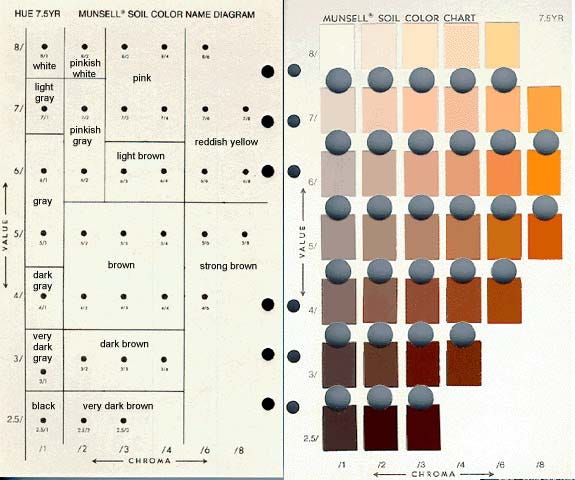
The brilliance of the Munsell system lies in its acceptance of imperfection. It does not promise absolute consistency. Rather, it offers comparability, recognizing that soil is never constant. It is a system designed for kneeling in dirt, for consideration, and for seeing. Munsell acknowledges soil as a living material rather than a standardized product.
Munsell, Pantone, and the Politics of Color
As of 2007 both the Munsell and Pantone systems are owned by X-Rite, a corporation specializing in color measurement, calibration, and digital color management. This convergence places tools developed from very different epistemologies under a shared technological and commercial infrastructure. Soil color charts and corporate brand palettes now coexist within systems designed to translate color into data, screens, and devices. The contrast between color systems becomes quite philosophical when you get into the dirt of it.
When Pantone emerged from the needs of industrial production, printing, and global branding, its colors were fixed, named, and proprietary. A Pantone color is designed to appear identical regardless of location, material, or environment. Authority here lies in standardization and control. Color becomes a code.

Soil resists this logic. No two soils are identical. Even within a single field, color shifts subtly across meters and depths. Moisture alone can transform appearance, darkening values and muting chroma within minutes. Attempting to Pantone-match soil is absurd. Soil cannot be owned chromatically. It cannot be stabilized without erasing the conditions that produced its color.
Soil resists full capture. Light shifts it. Moisture alters it. Touch transforms it. No scanner can account for the smell of wet earth or the granularity of a rubbed horizon. The Munsell system acknowledges this resistance. Pantone, by design, minimizes it.
Where Pantone names and fixes, Munsell describes and relates. One supports mass production. The other supports ecological literacy. Their coexistence exposes a tension between the possible uses of color: as a method to enforce an idealized world versus a metric used to describe the world as it actually is.
Why Soil Color Matters
To pay attention to soil color is not only an act of care toward the land but also an inquiry into how knowledge itself is structured. The systems used to describe color shape what is seen, what is ignored, and what is valued. In this sense, soil color becomes a site where epistemologies collide.
Munsell’s color system emerged from observation and inquiry. Developed by an artist and chemist rather than a corporation, it was grounded in perception, variability, and relational understanding. Its adoption in soil science reflects this orientation. Color is read situationally, informed by moisture, light, and context. Judgment, disagreement, and calibration are not failures of the system. They are essential to it.
Pantone represents a different value structure. As a proprietary corporate system, it is driven by standardization, reproducibility, and control. Colors are fixed, named, and owned. Difference is minimized. Authority is centralized. This logic works well for industrial production and global branding. It works poorly for living materials.
Soil resists being reduced to a fixed reference. Its color changes with water, touch, and time. It records processes rather than surfaces. In doing so, it exposes the limits of systems designed to enforce sameness. Soil demands forms of knowledge that remain responsive, provisional, and grounded in material reality.
Soil color matters because it reminds us that the ground beneath us is not passive matter but an active archive of life, labor, and disturbance. In choosing systems that describe rather than dominate, that observe rather than extract, we begin to align design and science with the intelligence already present in the earth.

Skylar Perez is a Mexican-American artist, researcher, and designer, whose work explores the intersection of microbiology, living systems, land use, and biodesign. Rooted in the semi-arid landscapes of the Llano Estacado, his practice investigates how soil and microbes can reframe the future of humanity through architecture and ecology, revealing the ground as both an archive and a living participant in shaping the earth. Currently pursuing his Ph.D. at Texas Tech University, Perez teaches and researches within the realms of biodesign, architecture, and plant–soil science. His work advances a vision of design as a regenerative system, where the built environment operates in dialogue with the biological and geological processes that sustain life on Earth. Designing against desertification.
A fantastic read! As an avid gardener I have always identified the condition of my soil by its color and texture and have never actually tested the PH of anything ever. This article made me feel like I was very "in-tune" with my land and my soil. "Soil demands forms of knowledge that remain responsive, provisional, and grounded in material reality." <-- I love that sentence so much!