

Critical Essays are reflective or theoretical pieces that link materials and making to broader cultural, ecological, or political questions.

Miles Matis-Uzzo sits at the edge of a giant hole in the ground while reflecting on the desert, vulnerability and negation, possibility and meaning, and what it is to be “taken.”
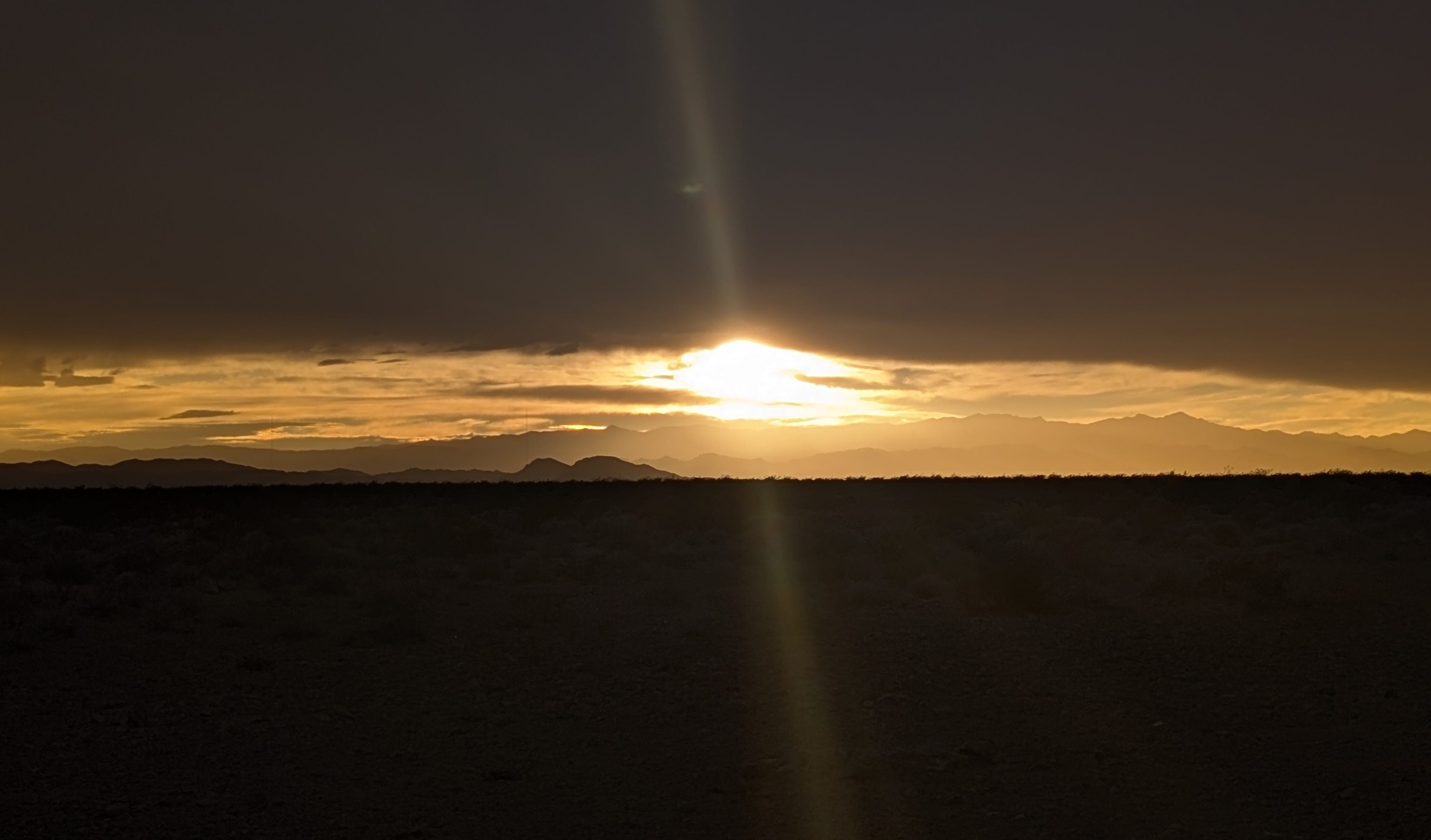
I sit on the precipice of a rectangular hole and keep thinking about the men I saw lingering at the edges of desert highways, hands in pockets, hoping the sky will take them.
They speak of Area 51 with a liturgy of coordinates, alien-themed restaurants, and the slow choreography of wanting to vanish. Is it boredom that sends them toward a beam of light, or a hunger so vast it might swallow the horizon? Or perhaps it is the pull of bottomlessness itself: the desire to drift endlessly, to fall into the atmosphere without limit, to inhabit a space where absence becomes somewhere new and exciting. The sky is not a ceiling but an invitation, and the act of longing itself turns into a kind of gravity, pulling us toward unknown shapes of being.
Sitting at the edge of Double Negative by Michael Heizer, I think of dynamite. Of the man who blew a clean, geometric absence into the Nevada cliff on Mormon Mesa. Not to create a path, but to leave a lingering vacancy—a deliberate, carved-out nowhere. That hole is a gesture of both subtraction and the production of possibility. A double negative turned into the architecture of “not here.” The cliff did not lose matter but gained a thing to move toward. Not-here made into a place. The dynamite-man made emptiness tangible with a gesture of deep loneliness and vulnerability that I suspect a historically prideful man like Heizer would never do purposely. The emptiness feels the same way a person might shape a tender absence in someone else’s life, or the way a body shapes the meaning of a room by not occupying it.
Abduction is never neutral. For some, the fantasy of being taken up into light feels like liberation; for others, being taken has always provoked fear. Desire for contact is not evenly distributed. It is inflected by histories of who gets to imagine being chosen, who feels expendable, who has already lived inside the machinery of disappearance. To long for an alien abduction is to stand at a particular angle to power, to claim absence as possibility rather than threat. For some, abduction is terror. For others, it is the only portal they can envision to a place of freedom.
Why would I want to be abducted by aliens? Abduction is an act of removal, a rewriting of a self not yet ready to be rewritten, a movement without consent. To imagine being abducted is to imagine surrender, to let one’s body and story be pressed into shapes not one’s own. The fantasy of alien abduction hums with the desire to be lifted from loneliness, to enter a network, to be rewritten into a plural mind. In this context, abduction is not only theft but translation: a chance to be reassembled into a new grammar of existence, even though that translation is never fully yours. The act is double-edged: the terror and the longing braid together, each giving shape to the other.
We look for meaning because if things simply are, if existence is an endless, uninterpretable scatter of stones and creosote, then we cannot shape our own fantasies into tools. Meaning is what lets us take action. If the desert is meaningless, you are a body that will rot and be re-mulched into earth, and no gesture matters. But meaning and fantasies allow us to act; they let us choose which absences to make, which holes to create, which myths to inhabit. Men who yell about UFOs are not only telling stories but they are daydreaming of an exit strategy from a life that feels too heavy to carry.
There is a double negative at work here: a refusal and a yearning. Not-here becomes elsewhere; not-belonging becomes belonging-to-something-strange and collective. The grammar of longing folds back on itself. To say “I am not” is sometimes the only way to say “I might become.” The rectangular hole in the cliff is both a negation and an invitation. It is the arithmetic of loss and possibility. A minus turned into a door.
Sitting on that precipice, smelling the heat in the soil and seeing the crushed gnats stuck to my sunscreen-doused arms, I feel both ridiculous and divine. Ridiculous because to fantasize about alien kinship is to admit a childish, cinematic hunger for rescue. Divine because the same imagination can be a radical tool—to imagine contact is to refuse the absoluteness of isolation. The hole in front of me shows me that fear and desire are intertwined. What fantasy follows you can also instruct you. The impulse to escape is not only a flight from boredom but a clumsy altar for a deeper insistence that we are to be moved, altered, and recognized.
I think of the song “The Bottomless Hole” by The Handsome Family, the one that played on our precarious drive to the edge of this hole. I think about the endless drop, the refusal of any final ground. To fall forever, never striking the floor, is to live inside a strange grace: the terror and wonder of bottomlessness. To be abducted is to enter a drift without end. Not hitting bottom is its own form of survival, an unfinishable sentence, a body caught in perpetual becoming.
But until I hit the bottom, I won’t believe it’s bottomless.
Like the hole behind a barn, like the men who pray for sky-lights, like me on this rim of dynamite-man’s absence: we live in search of a fall without end, a space where meaning and fantasy tumble together, again and again, into alien dark.

Miles Matis-Uzzo is an interdisciplinary artist in Austin, Texas. Their practice incorporates sculpture, poetry, scent, and performance to create digestive worlds where material and the body intersect. Matis-Uzzo’s work has been exhibited at the Design Museum of Chicago, The Anderson (Richmond), and the Visual Arts Center (Austin). They have attended artist residencies at ACRE, Ox-Bow, the NARS Foundation, and Otis College of Art and Design. In 2025, Matis-Uzzo received an MFA in Sculpture & Extended Media from the University of Texas at Austin and joined field research across the American Southwest with the Land Arts program at Texas Tech University.