

Studio Profile: an inside look at how one artist or collective organizes their studio as a living ecosystem—materially, economically, and relationally.

Inspired in part by Felix Gonzalez-Torres, Jen de los Reyes writes on forgoing a traditional studio space in order to commit resources to the three zones that hold her practice: community organizing, place-based work, and the kitchen.
It feels appropriate for me to set up my Studio Profile with an exchange between two artists who have had deep and lasting impacts on my work as an artist and educator—Tim Rollins and Felix Gonzalez-Torres:
TR: This is something that I’ve always wanted to ask you: why have you deliberately, obstinately decided for some reason not to have a studio?
FGT: Do you really want to ask me that?
TR: Yeah, because it’s very curious to me. It’s almost like making art on the dining-room table as a hobby. This is an amazing limitation. You don’t have the trappings of a studio: assistants, visitors, and all that. Issues of space and light are gone since your work is so sensitive to place and context. How do you determine the pieces? You say you don’t do drawings but I know you must do drawings, you must have some idea of what the piece is going to look like, so how do you begin?
FGT: I really don’t plan pieces using drawings. First of all, I usually dislike drawings by sculptors, they’re just so academic and expected. I don’t follow that prescribed mode. I do make drawings and photographs but they have their own specific function. They are not sketches of the sculptures, these are drawings that represent a parallel set of ideas. The reason why I don’t have a studio... I think that I’m very neurotic. Actually I guess I am neurotic. So having a studio would paralyze me completely. Just the idea that I would have a place where I had to go to work and make “something” scares the shit out of me. The studio is a scary stage set.
While I don’t see the studio as a “scary stage set,” like Torres I can and in some ways do identify as a kitchen table artist. I have only kept an official designated studio at three points in my career, and always because they have been institutionally provided to me and not something I sought out for myself. When I have received this kind of institutional support, I have often used the studio space in unorthodox ways that provide other forms of support for my practice—space for community meetings, or an extended classroom. One of the reasons I wouldn’t seek out a dedicated studio on my own is that the kind of work I engage in doesn’t necessitate it; it would also be an economic burden to carry, and those financial resources could be better allocated.
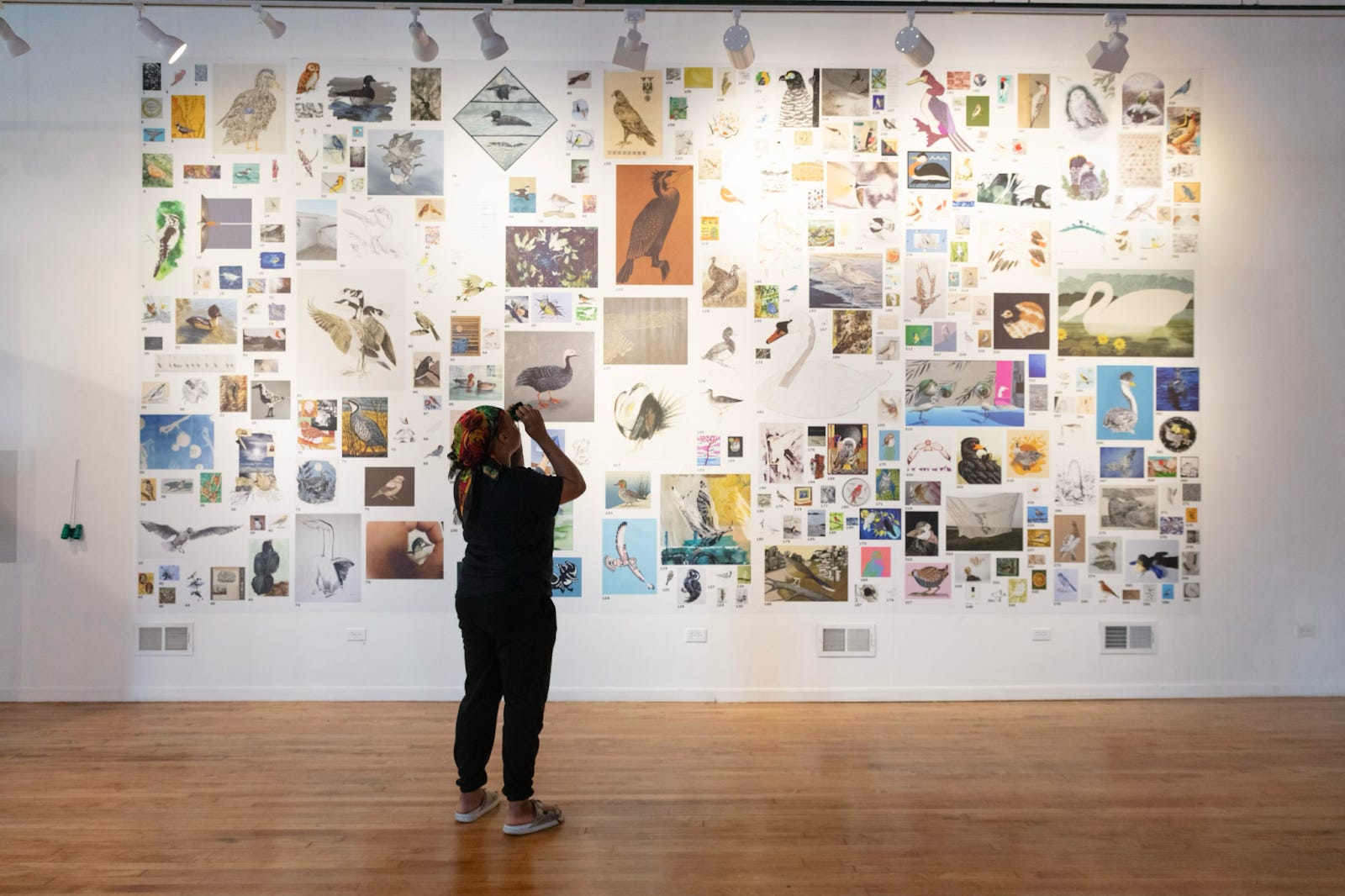
Triangulating the zones that make up my “studio” would encompass the following aspects of my practice: organizing and administration, land-based approaches, and the kitchen (not just the table!). I have done, and continue to do, a lot of work that involves communicating with many other artists. Open Engagement, one of the most notable aspects of my practice, entailed communicating with hundreds of artists over the course of years. For a more recent project I am working on with The National Audubon Society, I invited 389 contemporary artists to each interpret a bird on the list of their groundbreaking climate report “Survival by Degrees: 389 Bird Species on the Brink.” All of this means a lot of time sitting and doing admin.
The next zone of my studio is place-based work, most recently LAND. LAND is a site of research, cultivation, care, and conservation that I established with artist Oscar Rene Cornejo. The project combines histories of artists’ engagement with land-based practices and techniques with environmental regeneration and conservation to cultivate sustainable futures. Currently this means spending a lot of time outdoors working on plantings and conservation on site. LAND is also an extension of my classroom.
And now we get to the kitchen. By this I don’t mean that food is an aspect of my practice, though I do love cooking and if I were to make a career change, this would be the path for me. My current studio provided to me through my teaching appointment is equipped mostly with basic kitchen supplies—pots, hot plates, funnels, strainers, coffee filters, all of which I have been using to make inks and dyes from natural materials.
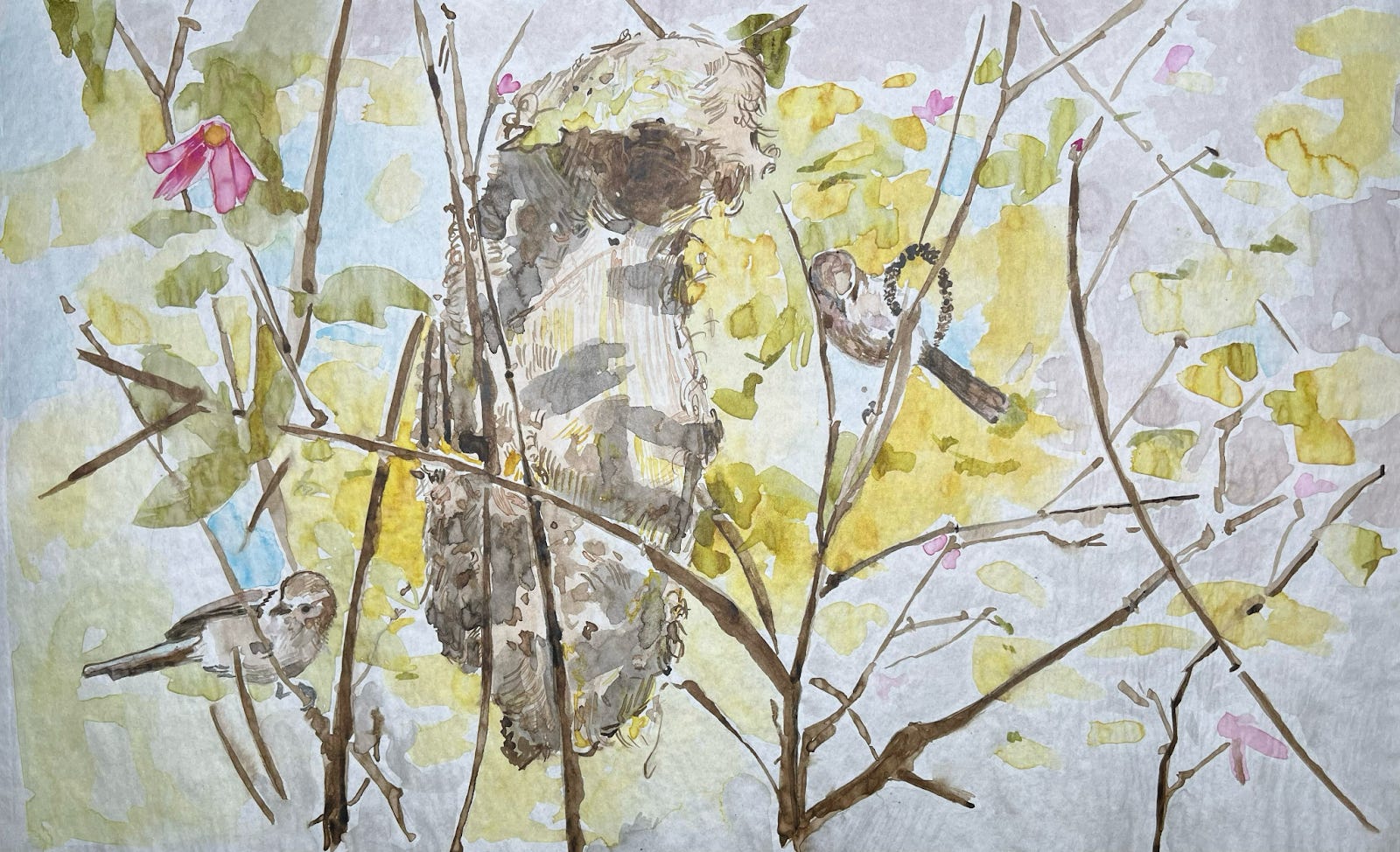
For a recent collaboration with Oscar for the earth dwell/ers school in Los Angeles, I wrote a birding field guide for the Sepulveda Basin Wildlife Reserve, and he made an artwork depicting the bushtit. The painting was created using natural inks and pigments I ethically foraged and processed. Many of same materials that are part of the ecosystems that support these birds also provided the materials to create these inks:
Green ink was made from buckthorn berries.
Browns are black walnut ink.
Black was created from charcoal ash from fallen branches.
Vibrant pink is from pokeberry.
Grays are from wild cherry ink.

Jen de los Reyes is an artist, educator, writer, and community arts organizer. With roots in the Riot Grrrl and DIY music scene, her practice incorporates pedagogical, ecological, and organizational methodologies. She founded and directed Open Engagement, an international conference on socially engaged art that was active from 2007–19. She worked within Portland State University from 2008–14 to establish the Art and Social Practice MFA program with a curriculum focused on place, engagement, and dialogue. Following that, Reyes was the Associate Director of the School of Art & Art History at the University of Illinois at Chicago, where she taught in the departments of Art and Museum and Exhibition Studies.
Her collaborative work and practice have been situated at institutions including the Carnegie Museum of Art, the Queens Museum, the Oakland Museum of California, MCA Chicago, and the Portland Museum of Art.
She speaks widely and has presented at the Brooklyn Museum, Bronx Museum, UCSB, UMass, NYU, Textile Museum of Canada, Museum of Contemporary Craft, Concordia University, Carnegie Mellon University, Minneapolis College of Art and Design, Milwaukee Art Museum, UC Berkeley, Alfred University, The Power Plant, and Project Row Houses amongst many others.
She is the author of several books, most recently Defiantly Optimistic: Turning Up in a World on Fire. She divides her time between Chicago, where she founded Garbage Hill Farm, and Ithaca, NY.