

Stories in Motion: Relational Organizing Through Art and Walking
A conversation with Maria Patricia Tinajero, Jay Salinas and Philip Matthews from Wormfarm Institute, and Mercedes Falk from Puentes/Bridges
Technique Case Studies are process-forward conversations or investigations with makers whose technical mastery reveals something larger about labor, embodiment, and care.
Walking + Talking (W+T): Stories in Motion is a socially engaged art project that brings together farmworkers, farmers, and neighbors in rural Wisconsin to move through shared landscapes while exchanging stories about labor, migration, soil, and belonging.
The project has two complementary aspects: collecting and sharing stories of the land through bilingual Spanish/English zine publications, and immersive long-distance walks to meet people and enact the most fundamental of all human activity: putting one foot in front of another to move across the earth.
Developed through collaboration among Wormfarm Institute, Puentes/Bridges, and Maria Patricia Tinajero, this relational creative project is shaped by encounters, trust, and the willingness to remain with complexity over time.
“Walking became so regular and familiar that the way home became home.”
In 2025, I walked a third of the 150-mile route between Wormfarm in Sauk County and Puentes/Bridges in Buffalo County. Along the way, I listened and learned from soil and from farmworkers who had immigrated from Mexico and Nicaragua; met artists who had relocated from major urban centers; and shared meals with families who have stewarded Wisconsin’s land across multiple generations. These encounters revealed a diverse community of people who understand that caring for land and caring for one another are inseparable practices, essential to the health, resilience, and abundance of Wisconsin’s working landscapes.
This growing season, I will walk one more time on the established routes and prepare to continue the journey north and west. Like the ecological processes of soil-building that inspire and guide the project, W+T evolves through cycles of composition and decomposition: stories are shared, assumptions are unsettled, and new understandings gradually take form through presence and dialogue.
As I considered how to approach this technical case study, I chose to publish an unfolding conversation among collaborators that is open, not fully resolved, and reflective of how W+T operates. Each attempt to fix it into a static form meets resistance. Perhaps the question is not how to finalize it, but how to remain in motion with it.
What follows is part of a live document that began with a guiding question: How does walking—slower, durational time—generate possibilities for building relationships and engaging more directly with the land?
Philip from Wormfarm (P):
I want to reshape the question a little further. As encounters—especially intercultural ones—gradually transform relationships between workers, farmers, and communities, how do we understand this process as a form of “social fermentation,” where time, trust, and coexistence generate new knowledge?
Mercedes from Puentes/Bridges (M):
For me, it’s been a learning process. My instinct is to be efficient—to respond quickly, to get things done. But I’ve realized that efficiency doesn’t build relationships. Relationships take time. They grow through small interactions—asking about someone’s day, sharing stories little by little. Eventually, those small moments open into something deeper.
Jay from Wormfarm (J):
That’s exactly where fermentation comes in. Fermentation is controlled decomposition—it’s something that’s going to happen anyway, but under the right conditions, it transforms into something else. Something richer. In our work at Wormfarm, we talk about a “starter culture,”and art as a social probiotic. You introduce something into a system, and it begins to shift how relationships evolve.
M:
That makes me think of something that happened a few weeks ago. Workers were coming in throughout the day for their health checkups, and I knew there would be a lot of waiting between interpreting appointments. So I brought a book with me about textile traditions from the Sierra mountains near Orizaba, where many of the farmworkers are from.
While we were waiting, we started looking at the book together. They began explaining things to me—how they use wool from sheep they raise, how they clean it, spin it, dye it.
Then Oscar—someone I’ve known for many years, but never really talked to in depth—saw the book and immediately recognized it. He flipped through the pages and found a photograph of his grandmother. She was standing outside her house, wearing a purple blouse, looking directly at the camera.
He began telling me stories about her—her love for sheep and textiles. There was pride in his voice and the quiet recognition of being heard. Waiting slowed time, and it became a shared moment of learning.
Maria Patricia (MP):
What you’re describing feels really important to how this project works. It’s not about extracting stories or documenting from a distance. It’s about being in relation—being present in those moments where something opens.
And I think that’s where walking and talking becomes a method. Stories emerge through attention, through curiosity, through being together.
So it’s not about controlling the outcome—it’s about setting the conditions.
J:
Exactly. I’ve always thought about my work as creating a format for phenomena to occur. You don’t start with a fixed endpoint. You set up the conditions—people, place, timing—and then you let things unfold. And along the way, you step in, you adjust, you respond. But you’re not dictating the result. The magic of these encounters happens when we create the conditions for them, not when we try to control them.
P:
I’m thinking about all the intentional decisions made at the beginning of this project: organizing the walks, connecting people, setting up encounters. But then there were moments none of us could have predicted. It started to feel like the project had its own intelligence—almost pushing back, shaping itself.
MP:
Yes, it pushes back in a recursive manner, which brings me back to the color purple of Oscar’s grandmother’s blouse in Mercedes’s story—not just as a color but as something that carries process and memory in its material dimension.
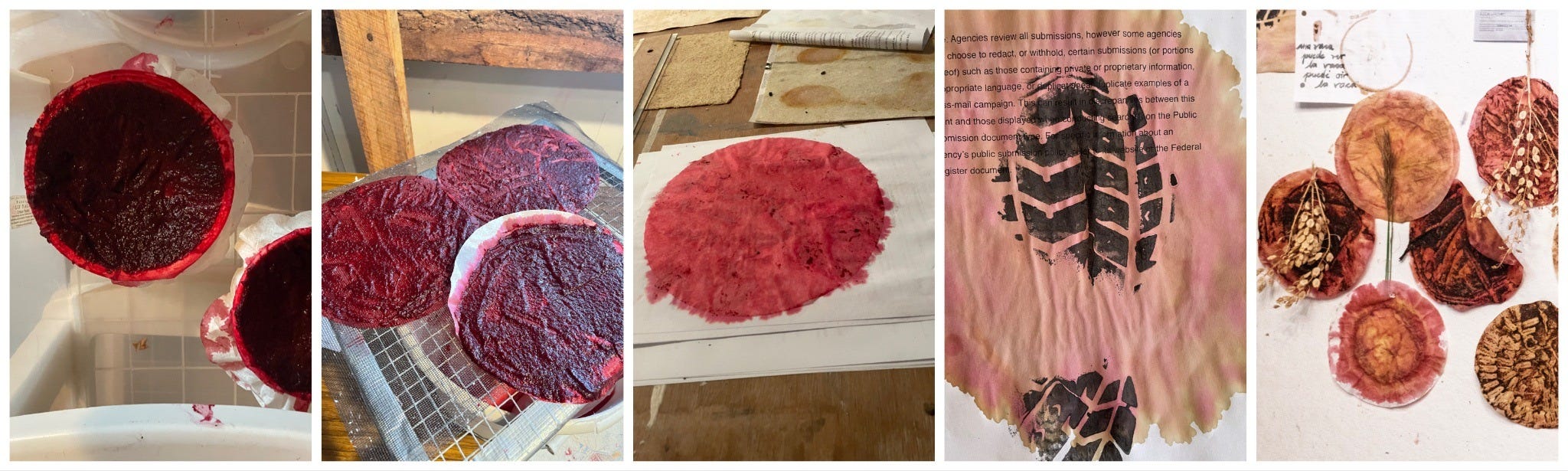
The materials that enter into the project also carry their own stories. I was walking with Jacque, a farmer who participated in the first year of the project, as we harvested vegetables for her weekend farmers’ market stand. After we finished, she gave me some beets, which I later used to make dye. That color became part of the project’s palette connecting it to the Wisconsin terroir.
This color—purple—showed me that building relationships extends in many directions, from human to more-than-human worlds. These directions, like beet dye, change as they oxidize, bringing a rich palette that evolves over time.
P:
I was at a conference where someone explained that purple isn’t a single wavelength. It’s what the brain perceives when red and blue overlap. It doesn’t exist in the spectrum in the same way—it’s created through relation.
And it made me think of something the poet Bhanu Kapil once described: grieving and dreaming happening at the same time. She called it a third river at the confluence of two others.
That idea feels very close to what’s happening here. These encounters—between people, places, histories—don’t simply merge. They generate something else.
MP:
Yes. And I think walking is key to that. Walking becomes a methodological tool—it shifts how we experience time. When you move through a landscape on foot, you enter a different rhythm, one that interrupts linear productivity.
Stories told while walking are not fixed. They change depending on where you are, what you encounter, who is present. A memory that comes up while moving is not the same as one told while sitting still.
For me, this is important because it shifts how information and knowledge are produced. It’s not about extracting stories or documenting from a distance. Stories are not collected—they’re co-created, emerging through shared attention and curiosity.
P:
I’ve been thinking about that as the difference between a photographic and a cinematic memory. A photograph captures something fixed—“this is how it was.” But a cinematic approach allows for movement. It lets the story unfold differently each time, depending on the present moment.
J:
And slowness is not just a preference—it’s part of the method. You can’t rush fermentation. The process takes the time it takes. It’s not an act of direct control but of indirect orchestration. It requires attention to environment—temperature, timing, microbial life—while accepting that transformation itself cannot be fully dictated. In this sense, the artist becomes less an author of outcomes and more a steward of processes. The work lies in initiating and tending to relationships, while remaining open to what those relationships generate over time. The goal is not to avoid uncertainty but to create the conditions under which uncertainty becomes productive.
It doesn’t happen because we push it—it happens because we slow down enough to let it emerge. And we’re always negotiating that tension between efficiency and relationship.
So then the question becomes: how do we evaluate work like this? If the focus is on process, maybe the criteria shift—from a finished form to the quality of the relationships, to what actually changes.
MP:
That’s very important to me. I don’t think of what I do as interviewing. It’s about being in conversation—sometimes through drawing, sometimes through walking, sometimes just sitting together and sharing a meal.
M:
And those conversations are evolving as the project continues. There are things people share now that they wouldn’t have shared a year ago. Relationships deepen. Trust builds. And that changes what becomes possible.
J:
Sure. For me that’s the network growing. At first, there are just a few connections. But then those connections multiply. They start linking in new ways. And with each new connection, the potential for change increases.
The project itself developed in this way. It began through conversations with participating farm hosts and artists along the 2024 Farm/Art DTour route. As the idea evolove into a walk connecting Wormfarm Institute and Puentes/Bridges. The artwork moved from metaphor to praxis, starting with existing relationships and gradually expanded outward through introductions, conversations, and invitations. Farmers, artists, organizers, and community members became connected through the process itself.
MP:
A useful visual here is that of weaving a rope. Each strand—conversation, gesture, encounter, artifact—contributes to a larger structure that is both flexible and enduring. The rope can be extended, knotted, or reconfigured; it does not have a fixed endpoint. Its strength lies not in any single strand, but in the way strands are twisted together.
P:
That also reflects how the project exists as an archive. It’s not just the zine. It’s everything—the recordings, the drawings, the conversations, even the things that never get published.
The first zine emerged from this process. Stories shared during walks and conversations were documented through recordings, notes, drawings, and photographs. These materials were then edited and assembled into a publication by Maria Patricia in collaboration with designers at Ope! Publishing. The zine does not document the project in its entirety; rather, it offers one way of gathering and sharing a portion of what was generated through these encounters. Leaving room for more stories to come along the next walks.
MP:
Yes, and that creates a challenge. Because at some point, decisions
Because at some point, decisions have to be made–what to include, what to leave out. The aesthetic and conceptual aspects of the project are primarily my responsibility, while collaborators contribute to the development of routes, logistics, and relationships that make the work possible. Even so, those decisions feel collaborative and provisional because they emerge from a larger network of conversations, encounters, and contributions. There are always stories that remain outside the frame.
But even those decisions feel collaborative. And also incomplete. There are always stories that remain outside the frame.
J:
That’s part of the process too. You generate a lot—more than you can use. And then you select, you refine. The rest doesn’t disappear—it becomes part of the compost. It feeds future work.
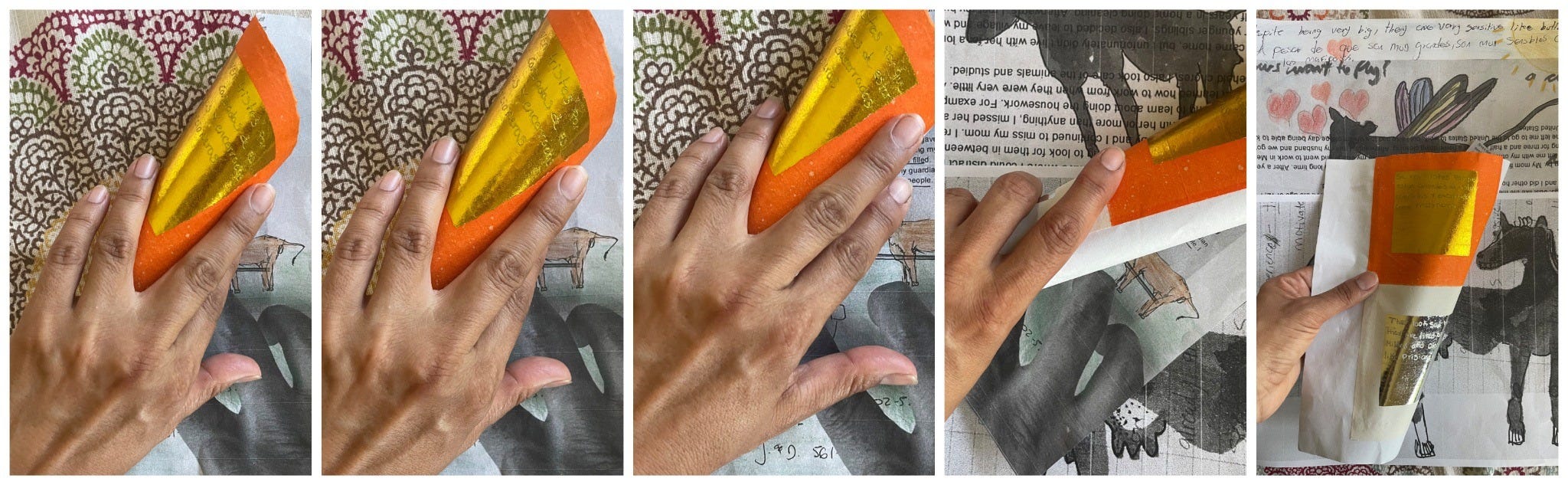
María Patricia Tinajero is an artist-philosopher whose interdisciplinary practice engages soil as a living, creative, and collaborative medium. Holding a Ph.D. in Visual Arts and Philosophy, she is the author of Becoming Soil, a poetic and political framework that invites us to reimagine our relationship with the ground beneath our feet. Her work bridges art, ecology, and philosophy, advocating for soil’s aesthetic dimensions and offering creative responses to the ecological crises caused by human activity. She was a 2023 and 2024 resident artist at the Wormfarm Institute in Wisconsin, USA. Tinajero is an active member of several art collectives that promote artistic collaboration and creative ecological thinking. With the Plant Contingent, she engages in performances and participatory projects that reimagine how we think and be with soil and plants. As part of the Ocean School Collective, she contributes to the development of open art school pedagogies that broaden ecological awareness and support eco-materialist modes of making.