

Legal Grounds: Serving as an Observer in the San Francisco Immigration Court
by Michelle Wilson
Technique Case Studies are process-forward conversations or investigations with makers whose technical mastery reveals something larger about labor, embodiment, and care. This feature provides an intimate look at a specific technique—whether centuries-old or newly emergent—through the eyes of a dedicated practitioner.
Michelle Wilson describes why the technique of courtroom sketching emerged in her artistic practice in the past year—first as an attempt to hold masked ICE agents accountable but ultimately as a method of documenting the breakdown of our court system. She recounts her time as a voluntary court observer in the San Francisco Immigration Court, sharing insights and reflections gained from this witnessing.

In the summer of 2025, as the Trump Administration was ramping up their deportation activities, I began serving as a Court Observer in the San Francisco Immigration Courts. My official mission was to be on the ground to witness any dismissals and to call the Bay Area Rapid Response Network to assure that attorneys could intercede in their possible deportations. Unlike other Court Observers, though, I had a secret mission: to draw the immigration courts. More precisely, I was going to try and draw ICE officers without their masks.
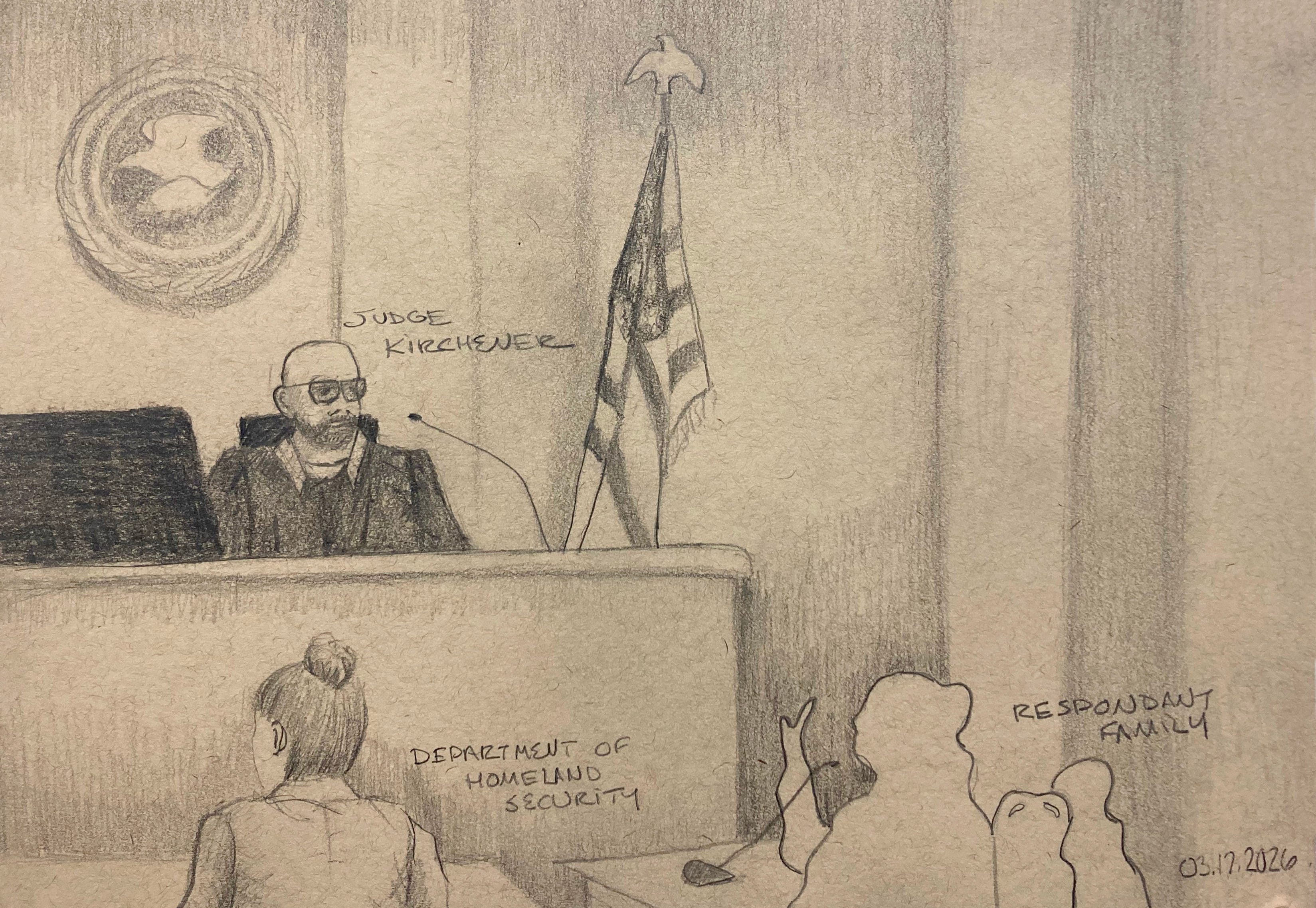
I’d like to say that when I arrived that first day I was cool and confident, walking in as if I belonged there. Instead I was a nervous, flustered wreck, and I wasn’t even on trial. I was uncertain how I was even going to make these drawings, because I knew that I needed to protect the identities of the asylum seekers in court.
The groundwork for my decision to serve in this capacity came shortly after the first No Kings March on June 14, 2025. That day, as I marched across Oakland with over 10,000 others, asylum seekers across the Bay Area received a notification on their CBP app to report to the formerly secret ICE Center located on Tahoma Street in San Francisco. Fearing the alternatives to not appearing, many immigrants showed up. However, no ICE officers were on site. I wondered if it was an attempt to divert people from the march.
Fortunately, many lawyers, including several from the San Francisco chapter of the National Lawyers Guild, turned up to assist asylum seekers with filling out the correct paperwork to demonstrate that they had complied with orders. To not show up, or to have no proof of showing up, could be grounds for deportation.
Deanna Mouton—then the vice president of the San Francisco chapter of the National Lawyers Guild and one of the people on site that day on Tahoma Street—expressed to me their frustration about ICE agents wearing masks during raids. Together, we began to brainstorm ways we could unmask them.
It occurred to me that one place masks are prohibited is the courtroom, where photography and video are also banned. As someone fairly skilled with a pencil and paper, I wondered if I could show up, draw, and possibly capture a likeness.
Dee connected me with one of the training sessions for Court Observers offered by the National Lawyers Guild, and soon thereafter I began my official stint as an undercover courtroom artist.
I quickly learned, though, that ICE agents are actually prohibited from entering courthouses, at least in San Francisco. But I’ve stayed to draw despite this. I believe these drawings bring greater visibility to the plight of immigrants and more transparency to the processes of asylum and immigration. In order to protect the identities of the vulnerable, I render the immigrants in question as silhouettes. However, I simultaneously aim to capture their body language, or some indication of their identities so as to not erase them completely. I am forced to render quickly—court sessions are fast, so most drawings must be completed within fifteen minutes.
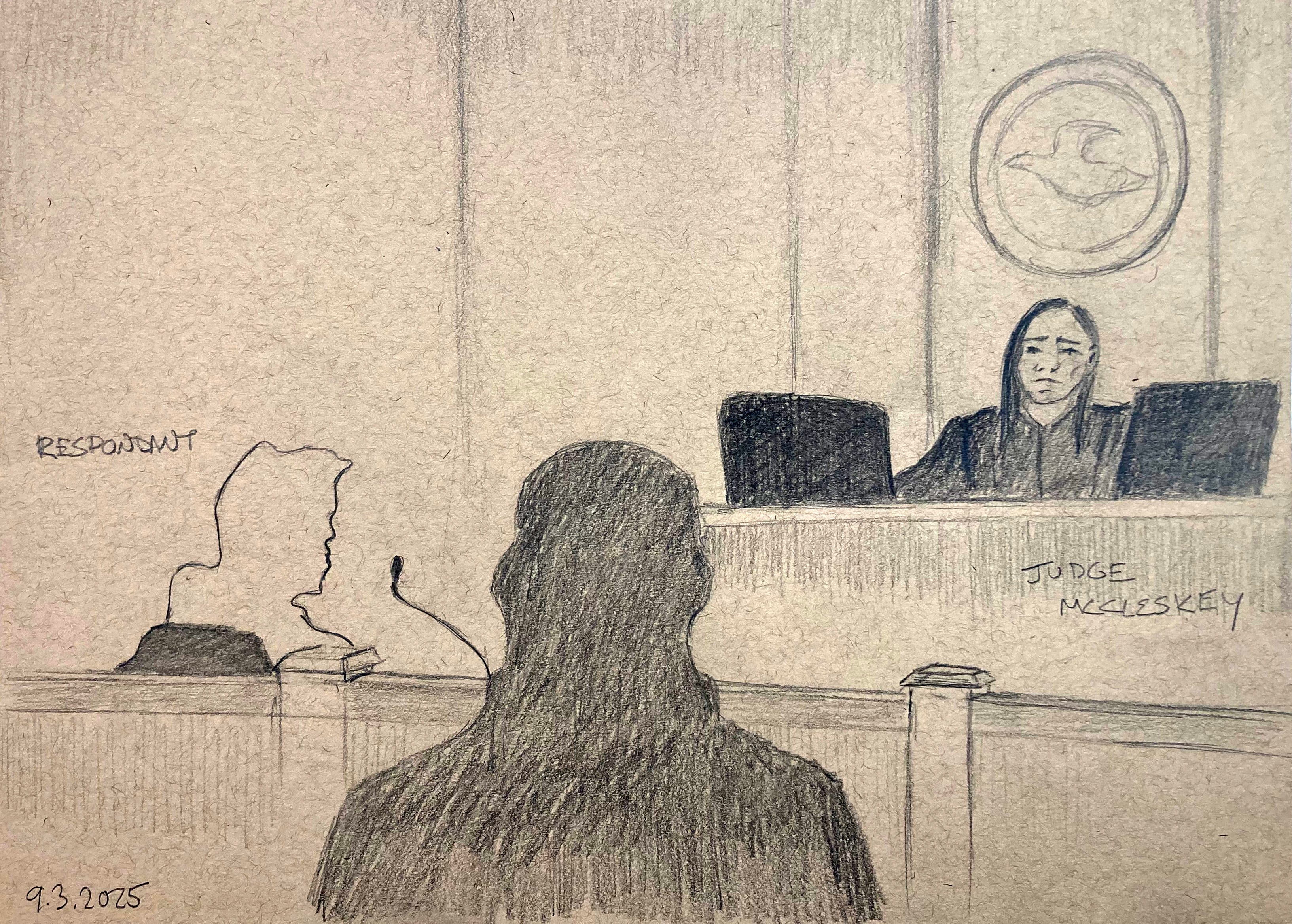
Dee assured me I could legally render the defendants as long as I drew them from behind and didn’t show their faces. Even so, I came to use silhouettes. This is in part because of logistics—sometimes I am not able to sit directly behind the asylum seeker, and when I do, it is difficult to capture the rest of the courtroom and the experience they are having.
On a more conceptual level, silhouettes leave an openness that a viewer can fill in—the person in that drawing could be any person. I hope this enables people to see themselves in these stories and, thus, increase a sense of empathy.
In addition to witnessing the stories of asylum seekers, my drawings have inadvertently become evidence of the breakdown of the San Francisco Immigration Court. Since September of 2025, all but seven of the judges on the court have been fired by the Trump administration for having “too high” of an asylum-granting rate. In January, three more judges retired. In March 2026, two more judges were transferred to other districts, leaving only two judges on the San Francisco court. There are plans to permanently close the court in January of 2027.
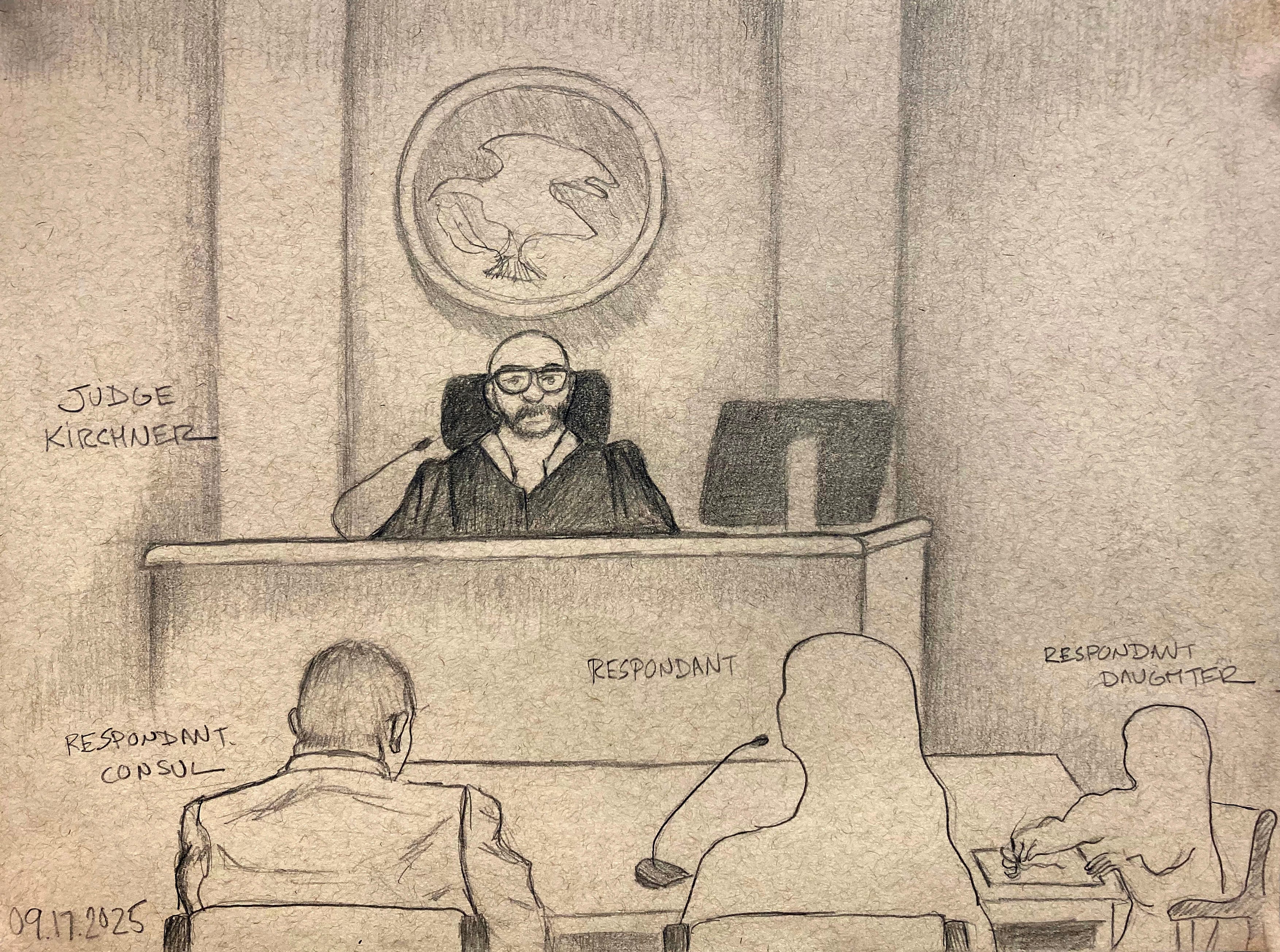
This destruction of the system from within is adding uncertainty and confusion to the process of gaining legal citizenship, and my works are documenting in real time how this is affecting a vulnerable population of people. The courts are overwhelmed and communications are going awry. Fewer judges also means fewer clerks to file paperwork.
I was recently in court when an asylum seeker was FTA (“failure to appear”), which is typically grounds for immediate deportation. Fortunately, when looking over their paperwork, the judge realized that some numbers in the address were transposed, and their court summons was likely sent to the incorrect address. In this instance, the judge extended their case and sent another summons, this time to the correct address. Unfortunately there are other times where asylum seekers were deported in spite of doing everything else “right” simply due to clerical errors made by the courts.


When I first started going to court, I hoped to remain anonymous. However, I was outed to the court early on by Judge Swink, one of the judges who has since been fired. Identifying me and my drawing was not out of animosity; rather, she seemed pleased that someone was paying attention.
To paraphrase the artist Anne Covell from her book Palpable Mass: amid periods of history such as ours, the use of chaos as a political tool to distract people from important issues causes people to be overwhelmed and become disengaged. This becomes a new normal, and the opportunity to dehumanize others, such as immigrants, becomes inevitable. Thus, during times like these, sustained attention is an act of resistance.
These drawings are my act of sustained attention as visual testimonies made on the ground of the struggles immigrants face today. More than anything, I know it is necessary for these drawings to be seen. As of now, I have almost fifty, although some are less complete than others. I’m uncertain of the archive or repository in which they may finally reside.


The experience of immigration court is a disturbing mix of monotony and anxiety; I am still determining how it has affected me. More importantly, the people who are affected most continue to live in fear of incarceration, of deportation, of being separated from their families. These drawings carry a part of their stories and experiences, and invite others to turn their focus and attention to the plight of immigrants during this regime.

Michelle Wilson is an interdisciplinary thinker, whose work involves papermaking, printmaking, book arts, installation, and social practice. She has exhibited her work both internationally and in the United States, including participation in biennials such as Philadelphia’s Philagrafika 2010 and the 2006 Second International Biennial for the Artist’s Book in Alexandria, Egypt. Her practice includes frequent collaborations with other artists; This includes her ongoing collaboration with Anne Beck as the Rhinoceros Project.
She is a past hand-papermaking advisor to Signa-Haiti, a non-governmental organization developing a sustainable and bio-dynamic economy in Haiti. Wilson currently teaches at San Jose State University and Stanford University, as well as workshops throughout the Bay Area and beyond. Wilson’s imprint is Rocinante Press. A former longtime resident of Philadelphia, Wilson now lives and works in the San Francisco Bay Area.